
Cutting out drywall?
Rebuild it waterproof. Fast!


DIY friendly. 🚛 Ships in 2 Business Days.
.png)
Ocean
surge
Rivers
Extreme rainfall
Rising groundwater
Overwhelmed infrastructure
This page focuses on the most important flood types affecting residential properties across the U.S., including coastal, riverine, flash, rainfall-driven, groundwater seepage, snowmelt events, and infrastructure-related flooding, plus one often overlooked scenario: sloped driveways channeling runoff even when the home itself sits on level ground.
Flood Risk Education Center
Understand the major types of flooding U.S. homes face and the hidden pathways that cause “unexpected” basement floods.

Common Flooding Sources:
Water Pathways Shape Flood Damage
Homeowners frequently think about flooding in terms of source, like storm surge, river overflow, tidal flooding, or heavy rain. Those sources matter because they help explain the overall hazard around a property.
But the damage a specific home experiences often comes down to pathways. In other words, how water actually reaches the structure and finds its way inside.
Two homes on the same street can have very different outcomes because their pathways are different. One may collect runoff at the garage. Another may take on water at a door threshold, or through the slab edge.
Common water pathways into a home include:

At the threshold
Water pushes through exterior doors, sliders, and other low door threshold entry points during flooding events.

Through the garage
Driveway runoff collects at the garage opening and enters fast through the largest opening on the home.

Across the slab edge
Water reaches the base of the wall and moves inward where the slab and wall assembly meet.

Up from below
Groundwater or hydrostatic pressure pushes water through basement walls, floor cracks, or lower foundation areas.

By exterior runoff
Improper grading, downspout discharge, and hard surfaces can funnel water directly toward the structure.

Vulnerable openings
Vents, utility penetrations, weep areas, and other small openings can become entry points during heavy water events.
7 Major Types of Flooding That Affect Homes Across the United States

Coastal flooding (storm surge, tides, wave-driven flooding)
Coastal flooding isn’t limited to major hurricanes. Water levels can rise during tropical storms, nor’easters, and strong coastal low weather systems. In low-lying areas near bays, canals, and tidal rivers, even moderate events can push water inland through streets and yards.
Common water pathways: ground-floor doors and windows, garage doors and low thresholds, crawlspaces, and water moving through neighborhoods that sit only slightly above sea level.

Riverine flooding (rivers, creeks, and watershed overflow)
River flooding happens when waterways exceed their banks—often after heavy rainfall upstream or rapid snowmelt. Unlike flash flooding, riverine flooding can build over hours to days and spread across floodplains.
Common water pathways: water moving across yards and streets, saturating soil and raising groundwater pressure near foundations, and infiltration into basements/lower levels.

Flash flooding (rapid-onset flooding)
Flash floods are about speed. Intense rainfall can create dangerous, fast-moving runoff within minutes—especially where terrain slopes, soils don’t absorb well, or storm drains can’t keep up.
Common water pathways: water flowing downhill into driveways, garages, stairwells, and low entry points; rapid pooling at low spots that were never designed to hold water.

Rainfall-driven / urban (pluvial) flooding
This is one of the most common “we’re not in a flood zone” surprises. Pluvial flooding occurs when rain overwhelms local drainage—regardless of rivers or coastlines. It’s especially common in suburbs and cities where pavement and rooftops create fast runoff.
Common water pathways: water moving along curbs, across driveways, and toward homes with unfavorable grading; storm drains clogged by debris; undersized culverts that cause neighborhood ponding.

Groundwater flooding and seepage (subsurface pressure)
Sometimes water enters a basement even when you don’t see flooding outside. That can happen when the water table rises and pressure forces moisture through cracks, joints, or porous materials below grade.
Common water pathways: wall/floor joints, cracks in slabs, foundation penetrations, and persistent seepage that worsens during multi-day rain events.
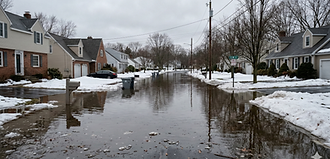
Snowmelt and rain-on-snow events (regional, but notable)
In colder climates, flooding can occur when temperatures rise quickly and snow melts faster than the ground can absorb—especially if the ground is frozen. Rain falling on snowpack can accelerate runoff dramatically.
Common water pathways: overloaded drainage systems and surface runoff that behaves similarly to heavy-rain pluvial flooding.
_edited.jpg)
Infrastructure-related flooding (stormwater, sewer backup)
In many areas, flooding is amplified by overwhelmed or aging systems—storm drains, combined sewers, blocked ditches, and undersized culverts. Sewer backup is a distinct but related risk, particularly for basements.
Common water pathways: floor drains/cleanouts (backup), neighborhood ponding (stormwater), and water routing failures around culverts.
A Hidden Flood Risk We See Often:
sloped driveways that feed garages and basements
This scenario is surprisingly common and often misunderstood. A homeowner may say: “Our house is on level ground. We’re not near a river. Why did the basement flood? The answer is frequently driveway geometry.
The setup
• The street sits slightly higher than the home’s garage slab
• The driveway slopes down toward the garage
• The garage connects to (or sits above) a basement or lower level
• During heavy rain, runoff concentrates and accelerates down the driveway
.png)
What happens in a major downpour
A sloped driveway becomes a channel. Water behaves like a small river: it collects at the top, gains speed downhill, and arrives at the garage door with force and volume.
Once there, it can:
• push under the garage door or around edges,
• pool on the garage slab,
•migrate through the door connecting the garage to the home, and ultimately find its way into the basement/lower level.
In these cases, it’s possible for a home to experience basement flooding even when the yard looks “fine.” The driveway becomes the dominant pathway.
Signs this risk applies to your property
You may be vulnerable to driveway-to-garage-to-basement flooding if you’ve noticed:
-
visible “streams” running down the driveway during storms,
-
debris/silt lines near the garage threshold after rain,
-
dampness at the garage edges or near the interior garage door,
-
recurring basement water after extreme rainfall events.
Why this is increasing in many areas
Even if your driveway never caused problems years ago, more intense rainfall events can overwhelm what used to be “good enough” drainage. A slope that handled typical storms can fail under modern downpours.
Key point: This is a rainfall/urban flooding pathway that can happen almost anywhere in the U.S.; not just in coastal or river regions.
Why More Homes Flood Repeatedly
Repeat flooding is rarely “random.” It’s usually the result of a stable set of factors:
Low
Points
(garage slabs,
basement stairwells,
window wells)
Limited Stormwater Capacity
(inlets, culverts, ditches)
Runoff Concentration
neighborhood grading directs runoff toward certain properties)
Below-Grade Vulnerability
(seepage and groundwater pressure)
Once you identify a home’s dominant pathways, repeated flooding becomes more predictable and planning becomes more practical.
Concentrated Rainfall Overwhelms Older Drainage Systems
Built for a Different Era
Many neighborhood drainage systems were designed decades ago for older rainfall patterns.
Today’s Rain Falls Harder, Faster
Storms are now more likely to dump heavier rain in shorter periods, which can overwhelm drains and force water backward.
Why That Matters for Homes
That overflow can increase the risk of water intrusion near basements and garages, even in places that did not flood the same way 50 years ago.
What to do With This Information
If you’re assessing risk or rebuilding after water damage, focus on the shortest path to clarity:
1
|
Identify your most likely flood sources (coastal, riverine, flash flood, rainfall, groundwater, snowmelt, infrastructure)
2
|
Identify your most likely flood sources (coastal, riverine, flash flood, rainfall, groundwater, snowmelt, infrastructure)
3
|
Choose a recovery-ready wall system (open the wall, inspect/dry the cavity, reinstall the same panels)
Want to see EnduraFlood in action? Watch videos.
Ready to plan your project? Use the Project Estimator.
Looking for the complete waterproof drywall guide? Waterproof Drywall Guide
The easiest way to create your material list is by using the Project Estimator.
For more installation tips, decoration ideas, information about new products, and more, don't forget to subscribe to our email list (don't worry, you can always unsubscribe).
For more installation tips, decoration ideas, information about new products, and more, don't forget to subscribe to our email list (don't worry, you can always unsubscribe).